
Summer is peak moving season on the Treasure Coast, and it is also peak season for moving scams. Florida strengthened its consumer protection laws in 2024 and 2025. Yet most residents still do not know how to verify a mover before handing over a deposit. This guide shows you how to check any company, spot the warning signs, and protect your belongings before you sign.
TLDR: Verify a mover’s FDACS registration before you book, and never accept a quote given sight unseen. Insist on a written estimate based on a walkthrough. Under Florida law, a mover who refuses to release your goods after you have paid can now face felony charges. A few minutes of checking protects you from the most common summer scams.
If you are planning a move this summer, read this before you call a single company. The Better Business Bureau confirmed in July 2026 that summer is the busiest stretch for moving fraud, and Florida families are a frequent target.
Picture the nightmare version. You booked a low quote by phone. On moving day, the truck is loaded, and the crew demands hundreds more before they will unload. Or the company you paid a deposit to simply vanishes. These follow patterns you can learn to recognize.
The good news is that every red flag has a matching green flag, and Florida now gives you real legal tools. You are smart for asking the question before anyone has your furniture on a truck.
Why Summer Is Peak Season for Moving Scams
Moving demand spikes every summer, and scammers follow the money. Families move before school starts. Retirees downsize. Snowbirds turn seasonal stays into permanent ones. All that volume creates confusion, and confusion is what fraudulent operators exploit.
The BBB and federal regulators receive the most mover complaints between May and August. Rogue movers often spin up quickly, run through peak season, then disappear before victims compare notes.
The Treasure Coast faces added pressure. Summer overlaps with hurricane prep, and rushed moves create the vulnerability scammers look for. When you hurry, you skip verification. That skipped step is where most scams begin.
The 5 Most Common Moving Scams
Moving scams follow predictable patterns. Knowing how each one works is your first line of defense. Here are the five most common types, all reported actively across Florida in recent years.
| Scam | How It Starts | What Happens | Florida Protection |
|---|---|---|---|
| No-Show | You pay a deposit to book | Moving day comes, the phone is dead | Only registered movers may take contracts |
| Bait-and-Switch | Low quote by phone, sight unseen | Price jumps once items are loaded | Written estimates required before loading |
| Held-Hostage Load | Vague verbal quote, no contract | Crew demands more before unloading | Refusing paid goods is a third-degree felony |
| Weight Upcharge | Quote based on estimated weight | New per-pound rate after loading | Binding estimates limit surprise charges |
| Broker Bait | You think you hired a mover | An unvetted carrier shows up | Brokers must register and disclose carriers |
The common thread in every one of these moving scams is the same. The victim did not verify the company before paying or signing. That part is completely fixable.
Red Flags to Watch For Before You Sign
Before you sign anything, run every mover through this checklist. Legitimate companies clear every green flag without hesitation. Warning signs tend to cluster, so if you spot two or three, walk away.
| Green Flag (What You Want) | Red Flag (Warning Sign) |
|---|---|
| Walkthrough before quoting | Firm price quoted sight unseen |
| Little or no deposit | Large cash deposit demanded |
| Registration number on trucks and contracts | No number visible anywhere |
| Marked company trucks | Unmarked or rental vehicle |
| Answers with the company name | Answers generically as “Movers” |
| Physical Florida address | Only a cell phone number |
| Clear written contract | Blank spaces or a rushed signature |
| Competitive quote | A price too good to be true |
Pro tip: Florida law requires registered movers to display their registration number on every vehicle and document. No number usually means no registration, so treat that as your signal to stop.
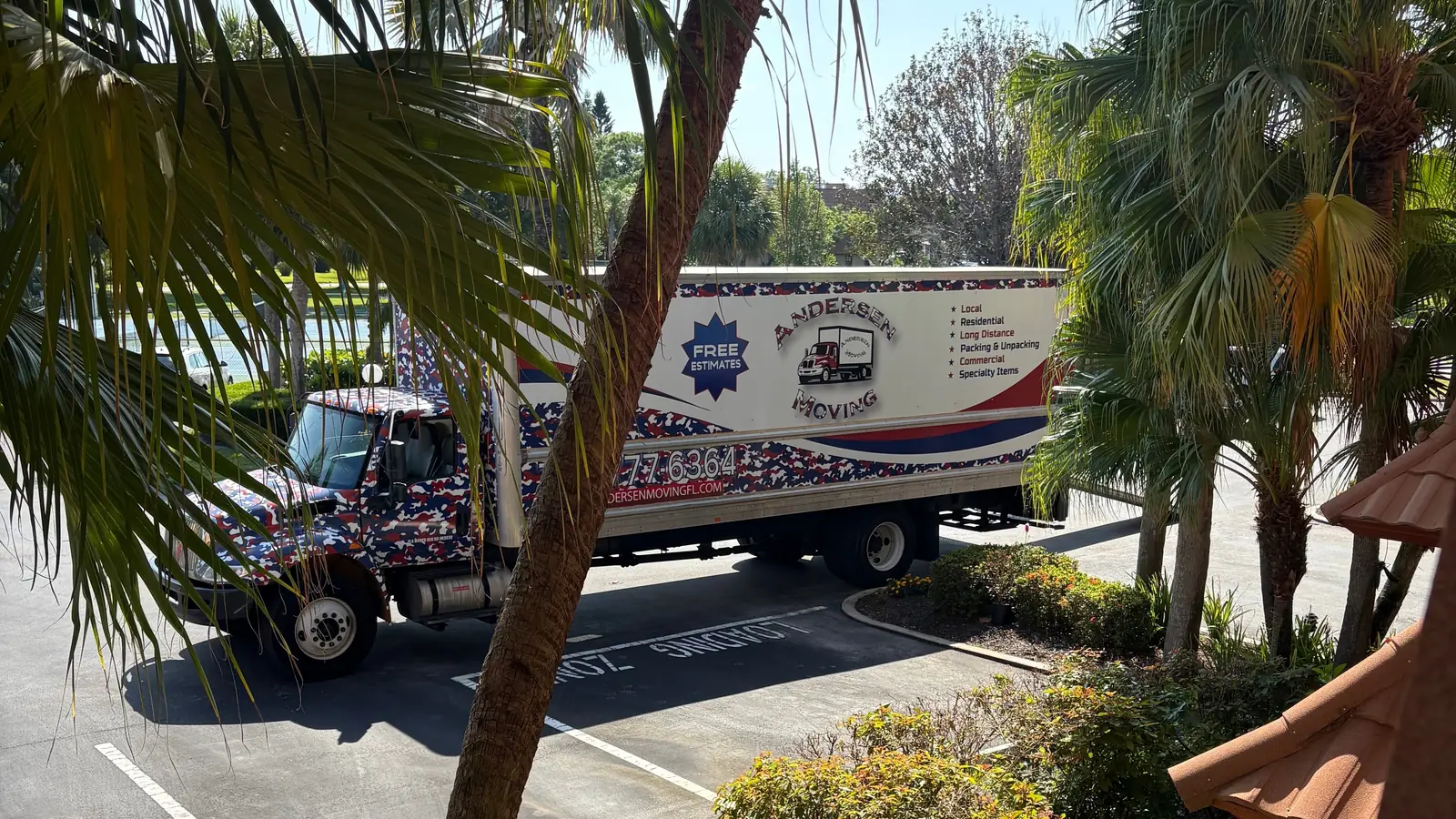
If you are checking Andersen Moving against this list, the registration is Fla. Mover Reg. No. 3030, verifiable at FDACS.gov. Estimates are written and based on a walkthrough, with no large deposit required.
How to Verify a Florida Moving Company Step by Step
This is the most important step for avoiding moving scams. Florida uses two separate systems to regulate movers, depending on whether your move stays in state or crosses state lines. Most Treasure Coast moves stay within Florida, so FDACS is your agency, not the federal FMCSA.
| Move Type | Agency | Verification Tool | What to Confirm |
|---|---|---|---|
| Within Florida (intrastate) | FDACS | FDACS Business License Lookup | Status “Active,” matching number |
| Crosses state lines (interstate) | FMCSA | FMCSA mover search | ”Carrier” not “Broker,” active status |
For moves within Florida, use the FDACS Business License Lookup to confirm a company is registered. Search the exact name on your estimate, not a shortened ad version. Confirm the status reads “Active,” then match the number online to your written estimate. If anything fails to match, call 1-800-HELP-FLA (1-800-435-7352) before you sign. You can review your rights on the FDACS consumer resources page.
For moves that cross state lines, use the FMCSA registered mover search tool. Enter the USDOT number, confirm the entity shows “Carrier,” and check that insurance is current. The federal FMCSA red flags checklist is a useful companion, and the FTC advice on avoiding moving scams reinforces the same warning signs.
Important: Andersen Moving holds Fla. Mover Reg. No. 3030 for moves within Florida. That is not a claim. It is a fact you can check right now on FDACS.gov. If you need a local move in Port St. Lucie, the credentials are ready to verify before you book.
Brokers vs. Direct Movers and Why It Matters
Here is a distinction that trips up most consumers and drives many Treasure Coast complaints. A moving broker is not a moving company. Brokers do not own trucks, do not employ movers, and are not responsible for the physical move.
A broker sells your booking to a third-party carrier you never vetted. When something goes wrong, accountability disappears, and you are dealing with a company you never chose. Many of the lowest-priced “movers” advertising online are brokers, not local operators.
Pro tip: Ask every company one direct question. “Will your own trucks and your own crew handle my move?” A direct mover answers yes without hesitation. When you book a Stuart moving company that owns its trucks, the crew that quotes your job is the crew that shows up.
What Florida Law Changed in 2024 and 2025
Florida’s moving laws got significantly stronger recently, and most residents do not know it. Scammers count on that gap.
| Requirement | What It Means for You |
|---|---|
| Mandatory FDACS registration | Only registered movers may quote and contract |
| Registration number display | The number must appear on trucks and contracts |
| Written estimates and contracts | You get terms in writing before loading begins |
| Hostage-goods penalty | Refusing paid goods is a third-degree felony |
| Multiple payment options | Movers must accept at least two payment types |
These protections only work if you use a registered mover. An unregistered company gives you almost no recourse, which is exactly why verification matters.
The hostage-load rule is the headline change. Under Florida Statute 507.11, a mover cannot refuse a law enforcement officer’s order to release your goods once you have paid the estimate amount. That refusal is now a third-degree felony. You can read the Florida Chapter 507 statutes directly.
What to Do If You Have Already Been Scammed
If you are reading this after the fact, you still have options. Move quickly and document everything.
- If your goods are held hostage, call 911 first. Refusing to release paid goods after a law enforcement order is a third-degree felony.
- File a complaint with FDACS for intrastate moves at 1-800-HELP-FLA or fdacs.gov.
- File with FMCSA for interstate moves through the FMCSA moving fraud complaint page.
- Contact the Florida Attorney General at 1-866-9NO-SCAM or the Florida AG site.
- Photograph the truck, the paperwork, and all payment receipts.
The process takes time, and calling 911 alone does not guarantee immediate charges. Still, the felony provision gives officers direct authority to order the release of your belongings.
How Andersen Moving Measures Up
Run Andersen Moving through the same checklist you would use on anyone else. Every green flag that helps you avoid moving scams describes how the company already operates.
The registration is Fla. Mover Reg. No. 3030, active and verifiable at FDACS.gov. Estimates are written and based on a walkthrough. No large deposit is required, the trucks are marked, and the crew that quotes your move is the crew that shows up. Andersen Moving is owner-operated by Ryan Andersen and has served the Treasure Coast since 2018, with a 5-star Google rating.
Our guide to the best time to move on the Treasure Coast pairs well with this one. For anything else, reach out through our Treasure Coast contact page.
Frequently Asked Questions
Q: How do I check if a Florida moving company is registered? A: Go to the FDACS Business License Lookup and enter the company’s exact legal name from your estimate. Confirm the status reads “Active,” then match the registration number online to your paperwork. The check takes about two minutes. If the status is not active or the numbers do not match, walk away and call 1-800-HELP-FLA.
Q: What is the difference between a moving broker and a moving company? A: A broker sells your move to a third-party carrier and does not own trucks or employ movers. A direct mover owns its equipment and crew and is accountable for the whole job. Ask directly whether the company’s own trucks and crew will handle your move. A straight answer tells you a lot.
Q: Is it legal for movers to hold my belongings hostage in Florida? A: No. Under Florida Statute 507.11, a mover who refuses a law enforcement officer’s order to release your goods after payment commits a third-degree felony. Call 911 first, then file with FDACS and the Attorney General. Enforcement takes time, but the tool is powerful.
Q: How much of a deposit can a Florida mover legally require? A: Florida does not cap deposits at a fixed percentage, but a large cash deposit is a primary red flag. Most legitimate local movers require little to none. If a company demands hundreds in cash upfront, treat it as a warning and get other quotes. Paying by card also gives you more protection.
Q: What should a legitimate moving estimate include? A: A written estimate based on an in-person or detailed video walkthrough. It should itemize labor, travel time, supplies, and valuation coverage. Any estimate given sight unseen over the phone is a red flag. Insist on seeing the terms in writing before anyone loads a box.
Q: Do Florida movers need to show their registration number on their trucks? A: Yes. Florida requires registered movers to display their number on vehicles, contracts, and advertisements. If you cannot find a number anywhere, the company is likely unregistered. That absence alone is reason to keep looking.
Q: What is the difference between FMCSA and FDACS for Florida moves? A: FDACS regulates moves that stay entirely within Florida. FMCSA regulates moves that cross state lines. Most Treasure Coast moves are FDACS territory. Verify with the agency that matches your move, and confirm the entity is a carrier, not a broker, for interstate jobs.
Q: How common are moving scams in summer? A: Very common. Summer is both the busiest moving season and the busiest scam season, and the BBB issued a specific summer 2026 warning for Florida consumers. Fraud reports rise year over year, and the Treasure Coast sees a mix of families, retirees, and transplants who are prime targets. Verifying before you book is the best defense.
Q: Can a low quote actually be a scam warning sign? A: Yes. A quote far below every other bid is a classic bait-and-switch setup. The low number secures your booking, then charges appear once your belongings are loaded. Compare several written estimates, and be cautious when one is dramatically cheaper than the rest.
Key Takeaways
- Verify before you book. Check FDACS registration for in-state moves and confirm the status is active before signing.
- Demand a written, in-person estimate. A firm quote given sight unseen is one of the most reliable warning signs.
- Know the broker trap. Ask whether the company’s own trucks and crew will do your move.
- Watch for red-flag clusters. No number, a large cash deposit, an unmarked truck, and a rushed contract rarely appear alone.
- Use your legal tools. Refusing paid goods is a third-degree felony under Florida Statute 507.11. Call 911 first in a hostage situation.
- Match the agency to the move. FDACS handles intrastate, FMCSA handles interstate.
- Document everything. Photos, contracts, and payment records make your complaint far stronger.
Ready to Move With a Verified Treasure Coast Mover?
You now know how to check any mover, spot the warning signs, and use Florida law to protect yourself. The next step is simple. Work with a company whose credentials you can confirm before you pay a deposit.
Andersen Moving has served Treasure Coast families and businesses since 2018, backed by a 5-star Google rating and Fla. Mover Reg. No. 3030. Every claim in this guide, from written estimates to no large deposits, describes how we operate.
Here is what we offer:
- Free, in-person or video estimates with no surprises on moving day
- Verifiable FDACS registration you can confirm at FDACS.gov
- Direct crews, marked trucks, and transparent written contracts
- Local knowledge of Port St. Lucie, Stuart, Jensen Beach, Jupiter, Palm City, and Palm Beach Gardens
- Registered, insured, and experienced moving teams
Ready to move forward? Contact us today:
Call: 772-777-6364
Website: andersenmovingfl.com
Go ahead and verify our registration first. We will wait. When you are ready, schedule your free estimate and let’s make your move a safe one.
Andersen Moving | Licensed, Insured Movers Serving Treasure Coast Since 2018